7 Proven Daily Planner Template Strategies for 2026


The modern workplace has reached a breaking point. In 2026, the average knowledge worker is interrupted every two minutes, losing an entire month each year simply searching for information.
Table of Contents
1.(#the-2026-global-productivity-crisis)
2.(#the-invisible-tax-of-information-fragmentation)
3.(#what-is-a-daily-planner-template)
4.(#the-neuroscience-and-psychology-of-handwriting)
5.(#step-by-step-guide-organizing-your-2026-planner)
6.(#neurodivergent-design-the-adhd-friendly-planner)
7.(#the-frontier-firm-ai-integrated-scheduling-agents)
8.(#workforce-dynamics-engagement-monitoring-and-flexibility)
9.(#comparative-analysis-of-2026-planner-tools)
10.(#dominating-search-intent-in-the-ai-era)
11.(#semantic-seo-and-lsi-keyword-architecture)
12.(#long-tail-keyword-integration-strategies)
13.
14.
The 2026 Global Productivity Crisis
The exponential demand for an effective daily planner template is inextricably linked to the escalating crisis of workplace inefficiency. Despite rapid advancements in enterprise software and collaborative tools, the fundamental capacity of the human brain to manage fragmented information has not expanded. The modern professional is subjected to an unrelenting barrage of digital demands, resulting in a measurable decline in sustained focus and output quality.
An extensive review of 2026 labor metrics, driven by the Productivity Lab's Workforce Utilization Benchmarks Report, reveals stark realities regarding daily work output.
To fully understand the scale of this operational failure, we must analyze the financial implications across different enterprise structures.
| Enterprise Size (FTEs) | Untapped Capacity / Productivity Loss Impact (Annual) |
| Large Enterprises (1,001+) |
Account for 50% of total financial losses. Annual cost per organization: $3.7M – $3.9M. |
| Mid-size Organizations (251–1,000) |
Experience annual productivity losses between $1.3M and $1.7M. |
| Small Organizations (0–250) |
Experience annual productivity losses between $162K and $542K. |
| Global Enterprise Benchmark |
Total annual productivity loss across tracked organizations is valued at $2.86 billion. |
These performance gaps are not evenly distributed across the global economy. Industry performance benchmarks highlight severe disparities in untapped capacity. The computer hardware sector suffers from a massive 71% underutilization rate, while aerospace reports a 19% untapped capacity resulting in $1 million in annual productivity loss per tracked unit.
The structural constraints of modern work dictate these failures far more than individual motivation. The typical knowledge worker is interrupted roughly 275 times during a standard 9-to-5 shift by emails, direct messages, and impromptu meeting requests—averaging an interruption every two minutes.
The Invisible Tax of Information Fragmentation
Beyond constant interruptions, the proliferation of specialized Software as a Service (SaaS) applications has created a dense, unnavigable tool stack. The 2025 Slite Enterprise Search Survey Report refers to this phenomenon as an "invisible tax on productivity".
This localized efficiency creates macro-level chaos. When searching for internal documents, enterprise search systems experience an alarmingly low first-attempt success rate of just 10%.
| Business Impact of Poor Information Architecture | Metric / Consequence |
| Weekly Time Wasted Searching |
3.2 hours per average worker |
| Annual Time Lost |
166.4 hours (More than one full working month) |
| Impact on Customer Service |
15% delay in customer service resolution |
| Impact on Deadlines |
9% of missed deadlines caused by search failure |
| Duplicate Work |
11% of time spent recreating existing solutions |
| Employee Frustration |
18% increase in worker frustration |
Furthermore, 34% of workers spend between 30 and 60 minutes daily simply waiting for responses from colleagues.
Compounding this fragmentation is the pressure of the modern "always-on" culture. Microsoft's telemetry shows that PowerPoint edits spike 122% in the final 10 minutes before meetings, while after-hours chats have increased by 15% year-over-year.
What is a Daily Planner Template?
To navigate this landscape, professionals must utilize precise organizational frameworks. The definition of these tools has evolved to encompass far more than basic calendaring.
Definition: Daily Planner Template
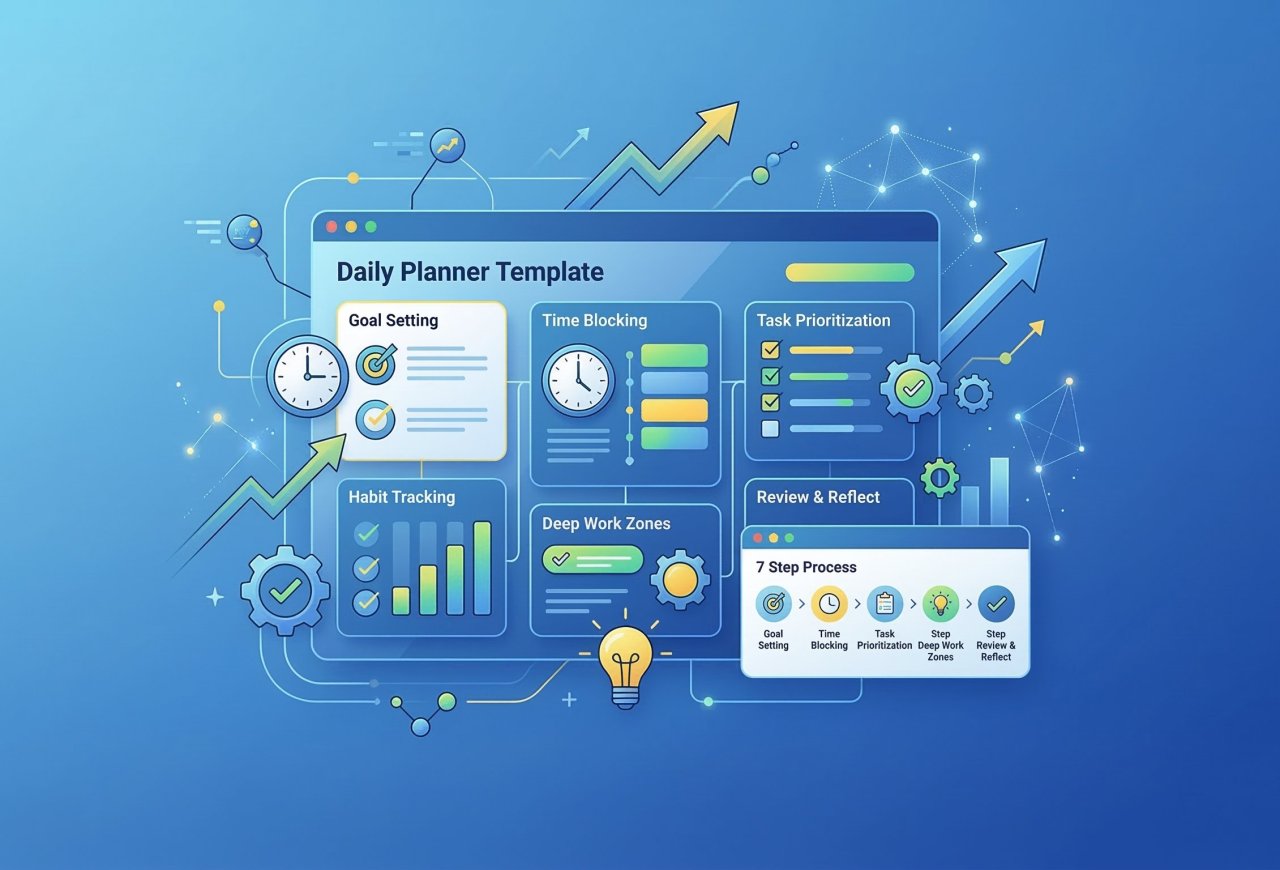
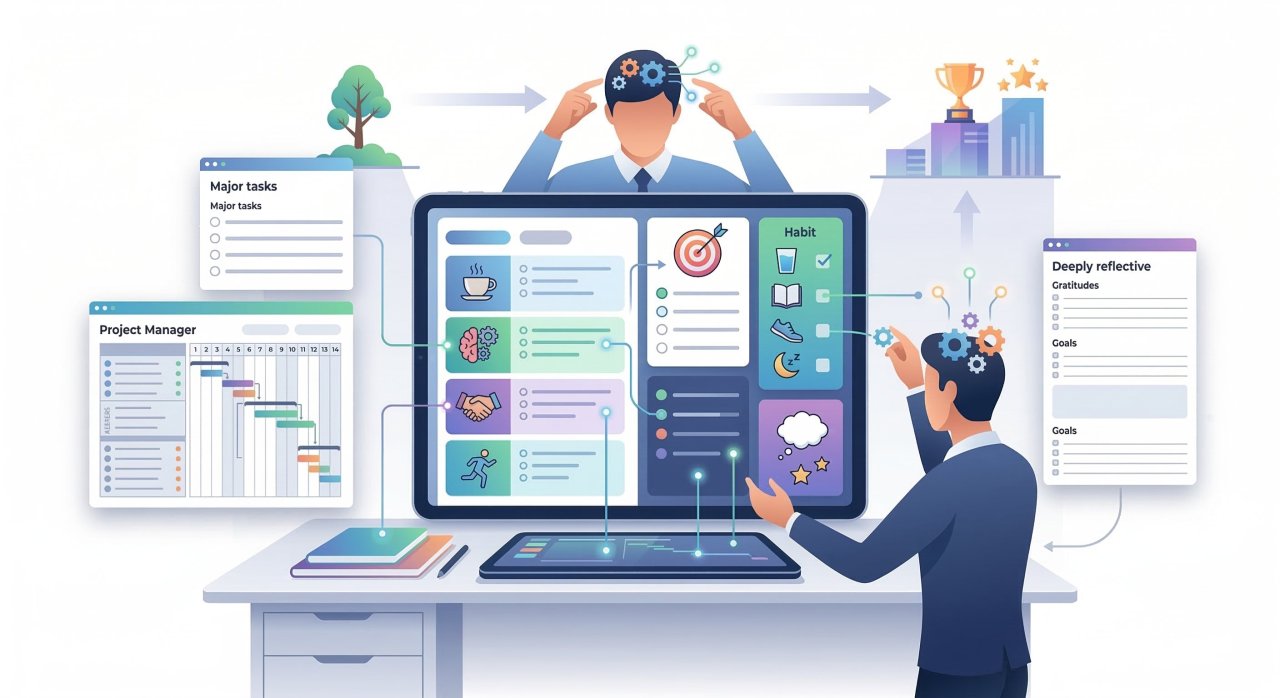
A daily planner template is a structured, customizable organizational framework utilized to orchestrate tasks, appointments, and long-term goals within a localized 24-hour cycle. Functioning as a behavioral modifier, it integrates dedicated sections for hourly time-blocking, priority identification, habit tracking, and cognitive reflection. These templates serve to reduce mental load, enforce behavioral accountability, and align immediate daily actions with broader strategic objectives, available in both physical, printable formats and interactive digital ecosystems.
The architecture of these documents has matured from simple, blank datebooks into sophisticated behavioral systems. Early iterations merely tracked appointments. Today, an effective template integrates specialized modules—such as hydration trackers, mood logs, financial budgeting blocks, and strategic priority matrices.
Modern templates are also highly modular and adaptive. Whether downloaded as a printable PDF or imported into a digital annotation application like GoodNotes, Notability, or Noteful, users can selectively deploy specific page layouts that match their immediate cognitive requirements.
The Neuroscience and Psychology of Handwriting
While digital scheduling applications dominate corporate infrastructure, the market for printable planner templates continues to experience exponential, sustained growth in 2026.
Studies originating from leading cognitive science institutions, including Princeton University and UCLA, demonstrate that handwriting engages the brain through entirely different, and highly effective, neural pathways.
Psychologically, the utilization of a physical daily planner template creates a "sacred time and space" completely devoid of digital noise.
Furthermore, behavioral accountability is heavily reinforced through tactile satisfaction. The physical sensation of crossing out a completed task on a paper template provides a superior dopamine response compared to clicking a digital checkbox, offering psychological motivation that apps rarely replicate.
Step-by-Step Guide: Organizing Your 2026 Planner
To extract maximum value from any planning system, the user must implement a consistent, strategic workflow. Haphazardly filling out a page inevitably leads to abandoned systems and compounded frustration. The following methodology ensures that the planner functions as a reliable engine for output rather than a tedious administrative burden.
-
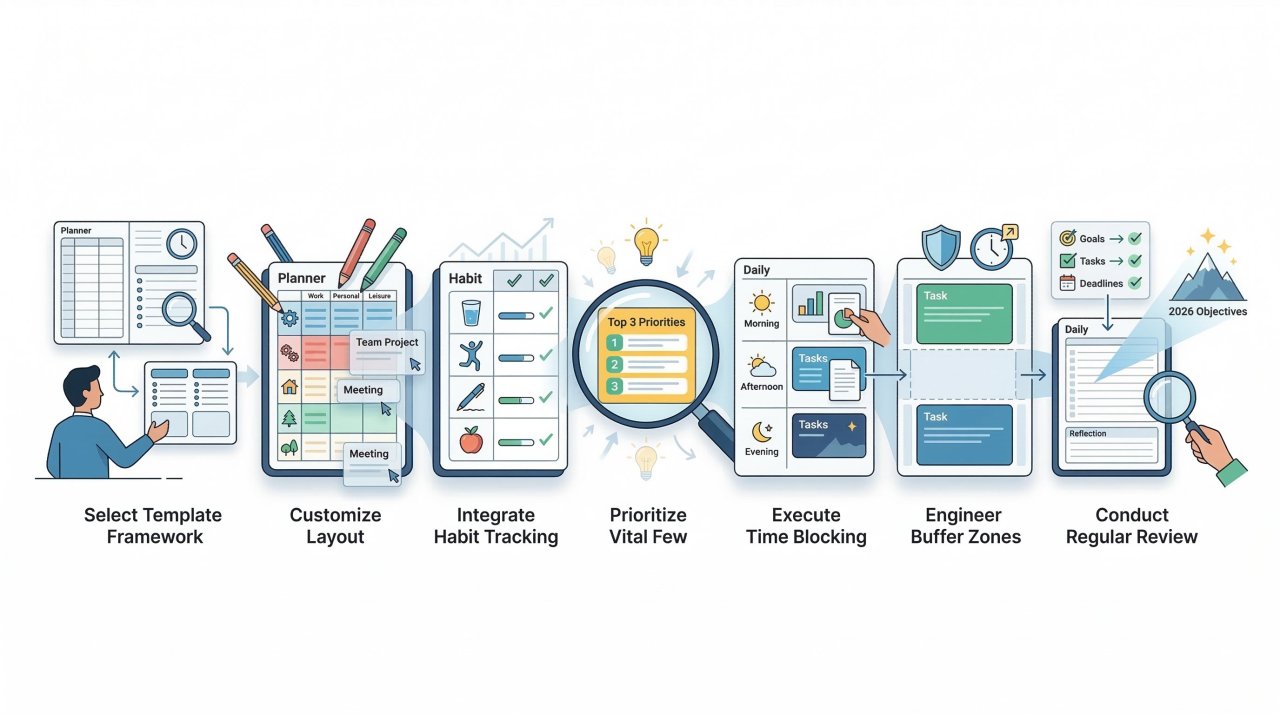
Select the Appropriate Template Framework: Begin by choosing a template that breaks the day into detailed time blocks.
Evaluate personal planning styles to determine whether an hourly vertical layout is necessary for dense meeting schedules or if a horizontal, task-oriented layout better suits flexible work. -
Customize the Initial Layout: Create essential sections for appointments, break times, and priorities.
Differentiate activities by using color-coding or symbols to visually distinguish between work, personal life, and leisure. Add specific modules for team projects, meetings, or family events. -
Integrate Micro-Habit Tracking: Incorporate a localized habit tracker for daily maintenance actions.
Monitoring variables such as water intake, physical exercise, or journaling ensures physiological baselines are met, keeping the user motivated and accountable. -
Prioritize the Vital Few: Begin every planning session by listing the top three priorities.
To ensure they stand out, highlight them using a special section, bold text, or a distinct color, ensuring they receive the highest cognitive energy. -
Execute Strategic Time Blocking: Divide the day into specific blocks (morning, afternoon, evening) and assign specific tasks to these blocks.
This method prevents overcommitting and minimizes the psychological friction of context switching. -
Engineer Buffer Zones: Deliberately leave space or "buffer times" between tasks.
These unallocated periods absorb unexpected delays or administrative overruns without cascading into schedule destruction or increasing stress. -
Conduct a Regular Review: Maintain structure by regularly updating sections for goals, tasks, and deadlines.
Review general notes and reflections daily to ensure immediate actions remain perfectly aligned with long-term 2026 objectives.
By strictly adhering to this structured methodology, the user transforms the daily planner template from a passive repository of obligations into an active, highly effective tool for workload orchestration.
Neurodivergent Design: The ADHD-Friendly Planner
A profound and highly necessary shift in the 2026 planner ecosystem is the widespread emergence of neuro-inclusive design architectures. Standard organizational tools frequently fail individuals with Attention Deficit Hyperactivity Disorder (ADHD) because they are designed under the assumption of neurotypical executive function. Traditional planners rely on the user possessing an internal, consistent ability to prioritize tasks intuitively, initiate complex projects without friction, and estimate time accurately—skills that are neurologically impaired or inconsistent in the ADHD brain.
The modern ADHD-friendly daily planner template actively scaffolds these missing executive functions through specific visual and structural mechanics.
Furthermore, these specialized templates incorporate sophisticated dopamine mapping techniques. Because the neurodivergent brain requires higher baseline levels of stimulation to initiate action, these planners break formidable projects into microscopic, actionable increments coupled with integrated reward charts.
In digital environments, this neuro-inclusive design extends to notification management. The updated 3.0 versions of popular ADHD Notion templates include carefully calibrated notification centers and time-blocking features designed to turn chaos into clarity, allowing users to focus without the paralyzing effects of sensory overload.
The Frontier Firm: AI-Integrated Scheduling Agents
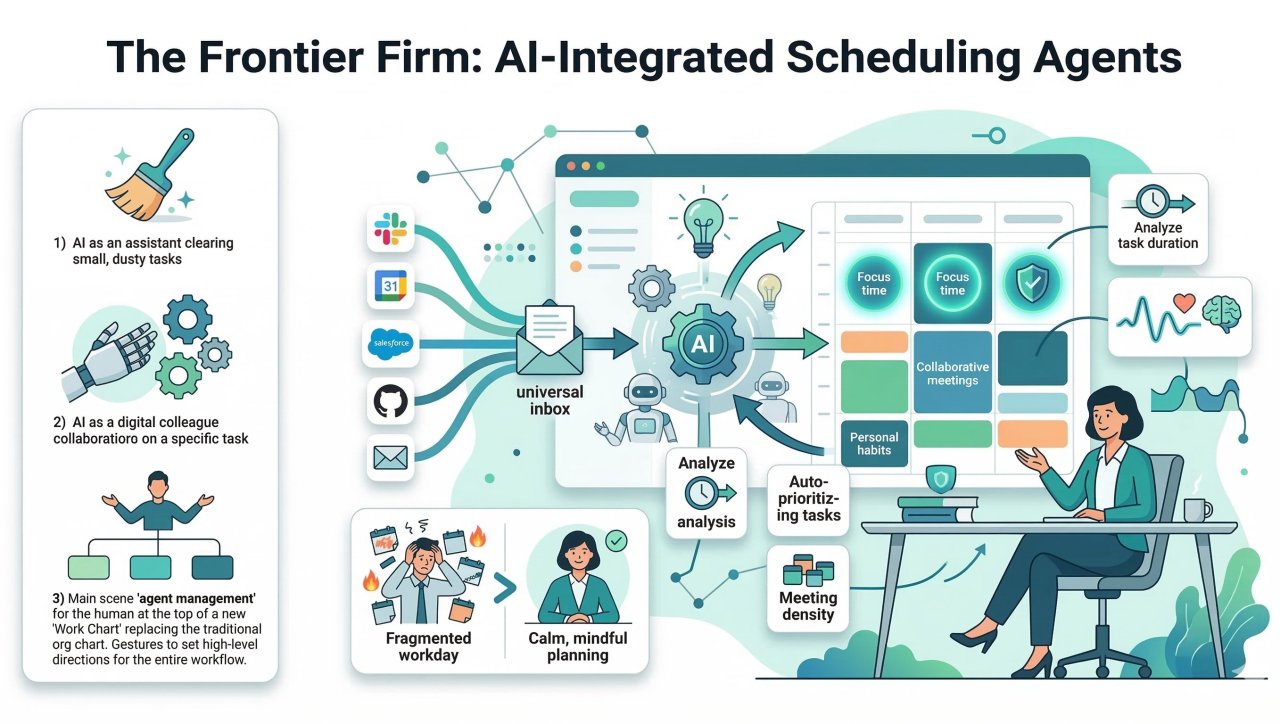
Parallel to the resurgence of physical handwriting tools is the aggressive expansion of artificial intelligence in digital scheduling. In 2026, the concept of the "Frontier Firm"—an organization heavily reliant on AI agents, "intelligence on tap," and automated workflows—has redefined the expectations placed on digital calendars.
According to the Microsoft Work Trend Index, 82% of organizational leaders consider 2025/2026 a pivotal era to rethink strategy via AI deployment.
Applications such as Morgen, Sunsama, Akiflow, and Reclaim AI dominate this autonomous scheduling sector.
| Advanced AI Planner Tool | Standout Feature / Capability | Target User Profile |
| Morgen |
Unified calendar + task view to drastically reduce context switching. Deep integrations. |
ADHD brains and neurodivergent professionals who require strict control and integration. |
| Sunsama |
Guided daily planning workflows that actively prevent over-scheduling and reduce overwhelm. |
Professionals demanding calm, mindful planning and strict work-life boundaries. |
| Akiflow |
Universal inbox consolidating tasks from multiple SaaS tools. "Aki" AI chat assistant for auto-assignment. |
Professionals in hyper-fast-paced environments managing dense tech stacks. |
| Reclaim AI |
Automated weekly planning, habit protection, and dynamic "Focus Time" generation. |
Individuals who want AI to entirely handle the geometry of scheduling decisions. |
This automation is specifically designed to combat the intense fragmentation of the modern workday. By consolidating inputs from disparate platforms—such as Slack messages, Google Calendar events, Salesforce updates, and GitHub tickets—into a singular universal inbox, these tools eliminate the massive cognitive penalty associated with application switching.
However, the deployment of generative AI in planning requires careful, human-centric calibration. While these tools can accelerate task completion rates by 12% to 16%, 77% of surveyed employees indicate that AI integration has paradoxically increased their total workload.
Workforce Dynamics: Engagement, Monitoring, and Flexibility
A daily planner template does not exist in a vacuum; it functions within the broader psychological context of the modern workforce. The ADP Research "People at Work" report provides vital context regarding why professionals are desperately seeking personalized planning tools to reclaim autonomy.
Global worker engagement sits at a record high, yet that figure is still only 19% of workers worldwide describing themselves as fully engaged.
Furthermore, the psychological toll of corporate monitoring is driving employees toward offline planning tools. Nearly one-third of global workers state their employers constantly watch them on the job.
In contrast, environments that champion trust and flexible autonomy see massive productivity gains. Remote-only workers average 29 more productive minutes per day than office counterparts.
Comparative Analysis of 2026 Planner Tools
Selecting the optimal system requires matching the specific operational mechanics of the planner with the psychological profile and professional requirements of the user. Beyond AI schedulers, the physical and digital-annotation landscape is sharply divided by layout architecture.
| Planner Brand / Layout Type | Core Formatting Methodology | Ideal User Profile |
| Hemlock & Oak: Vertical Weekly |
A5/B5 minimalist vertical scheduling with strict hourly increments. |
The portable, minimalist scheduler who relies heavily on time-blocking. |
| Hemlock & Oak: Horizontal Weekly |
Minimalist horizontal bands prioritizing task lists over hourly schedules. |
The flexible, creative planner who requires expansive note-taking space. |
| Bloom Planners: 6-Month Daily |
Dense daily pages dedicating an entire page to a single 24-hour cycle. |
Users with full schedules requiring intense time-blocking and goal tracking. |
| Notability 2026 Digital Collection |
Hyperlinked PDF navigation, high-fidelity handwriting simulation on tablets. |
iPad users seeking the tactile benefits of handwriting combined with cloud sync. |
| Printabulls / Vertex42 |
Free printable PDFs and Excel templates for 30-minute increment planning. |
Budget-conscious professionals or night-shift workers needing full 24-hour views. |
| Passion Planner |
Combined hourly appointment calendar with deep reflection questions. |
Bullet journal enthusiasts and individuals focused on holistic life design. |
This structural diversity guarantees that regardless of an individual's specific cognitive constraints, meeting density, or environmental demands, a precisely engineered system exists to optimize their daily operational output.
Dominating Search Intent in the AI Era
Transitioning from the structural mechanics of planners to the digital marketing strategies required to distribute them, the 2026 SEO landscape presents formidable challenges. For creators, brands, and publishers, ranking a resource for a highly competitive commercial query like daily planner template requires moving far beyond traditional keyword insertion and embracing the algorithmic nuances driven by generative AI.
Search intent detection is now fully automated, and search engines effortlessly distinguish between users seeking informational guides, those executing transactional template downloads, and those requiring software comparisons.
To capture visibility across Google, ChatGPT, and Perplexity, content strategists must operate on a rigorous foundation of E-E-A-T (Experience, Expertise, Authoritativeness, and Trustworthiness).
Furthermore, optimizing for AI search environments mandates an understanding of "query fan-out." When a user queries an AI search engine about organizing a schedule, the AI mode breaks that single question into 8 to 12 distinct sub-queries, running them in parallel across the web.
Visibility must also be measured differently in 2026. Tracking standard blue-link rankings on traditional SERPs is no longer sufficient. Elite marketers utilize tools like Ahrefs' Brand Radar to monitor how frequently their specific daily planner template brand is cited directly within the conversational outputs of AI platforms.
Semantic SEO and LSI Keyword Architecture
The mechanics of ranking long-form, authoritative content have shifted definitively toward semantic SEO. Algorithms powered by Natural Language Processing (NLP) and bidirectional transformer models no longer rely on exact-match keyword density to determine a page's relevance.
To build deep topical authority, content must incorporate LSI keywords (Latent Semantic Indexing variations). These are conceptually related terms that reinforce the core subject matter, helping search engines understand the scope, depth, and context of the article.
A highly optimized document covering this topic must weave in semantic variations such as time blocking, habit tracking, printable planner templates, ADHD-friendly, executive function, and productivity trends 2026.
Executing this strategy efficiently requires sophisticated LSI keyword generators and content scoring platforms. Tools such as LSIGraph, Clearscope, Surfer SEO, and Ahrefs analyze top-ranking competitors to identify the exact semantic gaps in a draft.
Long-Tail Keyword Integration Strategies
While securing top rankings for a broad head term like "planners" is an impressive vanity metric, the vast majority of highly qualified, conversion-ready traffic is captured through long-tail keywords.
A consumer typing just "planner" into a search bar is likely in the earliest stages of the research funnel, browsing aimlessly. Conversely, a user querying "best undated minimalist daily planner template PDF" or "ADHD-friendly time blocking printable 2026" possesses immediate transactional intent.
Identifying these lucrative opportunities requires leveraging advanced research tools like Ahrefs Keywords Explorer, Semrush, KWFinder, and Ubersuggest to filter databases based on keyword difficulty (KD), search volume, and precise search intent.
Frequently Asked Questions (FAQ)
Are printable daily planners better than digital ones? Printable daily planners are highly effective for users suffering from digital fatigue and cognitive overload. Research indicates that writing by hand engages multiple brain regions, reduces cognitive load, improves memory retention, and creates a distraction-free environment.
How do AI planners improve daily scheduling? AI planners, such as Morgen, Reclaim AI, and Akiflow, utilize machine learning algorithms to automate the entire scheduling process. They analyze a user's task list, meeting density, and available working hours, automatically allocating tasks into protected time blocks.
What makes a daily planner ADHD-friendly? An ADHD-friendly planner is specifically designed from the ground up to support impaired executive function.
How do semantic keywords impact SEO for planners? Semantic keywords (or LSI keywords) help search engines understand the full context, scope, and depth of a webpage.
What are the essential sections of a daily planner template? A highly functional daily planner template must include a prioritized task list (strictly limited to three vital objectives), a structured hourly or half-hourly time-blocking column, a dedicated area for habit or physiological tracking (like water intake), and a space for end-of-day reflection.
Conclusion
The evolution of the daily planner template in 2026 reflects a profound societal attempt to reclaim cognitive autonomy amidst an increasingly chaotic, fragmented digital landscape. The labor and macroeconomic data are unequivocal: attempting to manage the immense complexities of modern knowledge work without a rigorously structured external framework results in severe productivity gaps, heightened psychological stress, and massive organizational financial losses.
For creators, brands, and digital marketers operating within this multi-billion dollar space, achieving visibility requires a highly sophisticated blend of behavioral understanding and advanced algorithmic optimization. By mastering semantic SEO, answering hyper-specific long-tail search intent, and structuring digital content for both traditional web crawlers and generative AI platforms, brands can dominate this vital market sector.