Top 5 Best Time Management Books to Reclaim Your Day
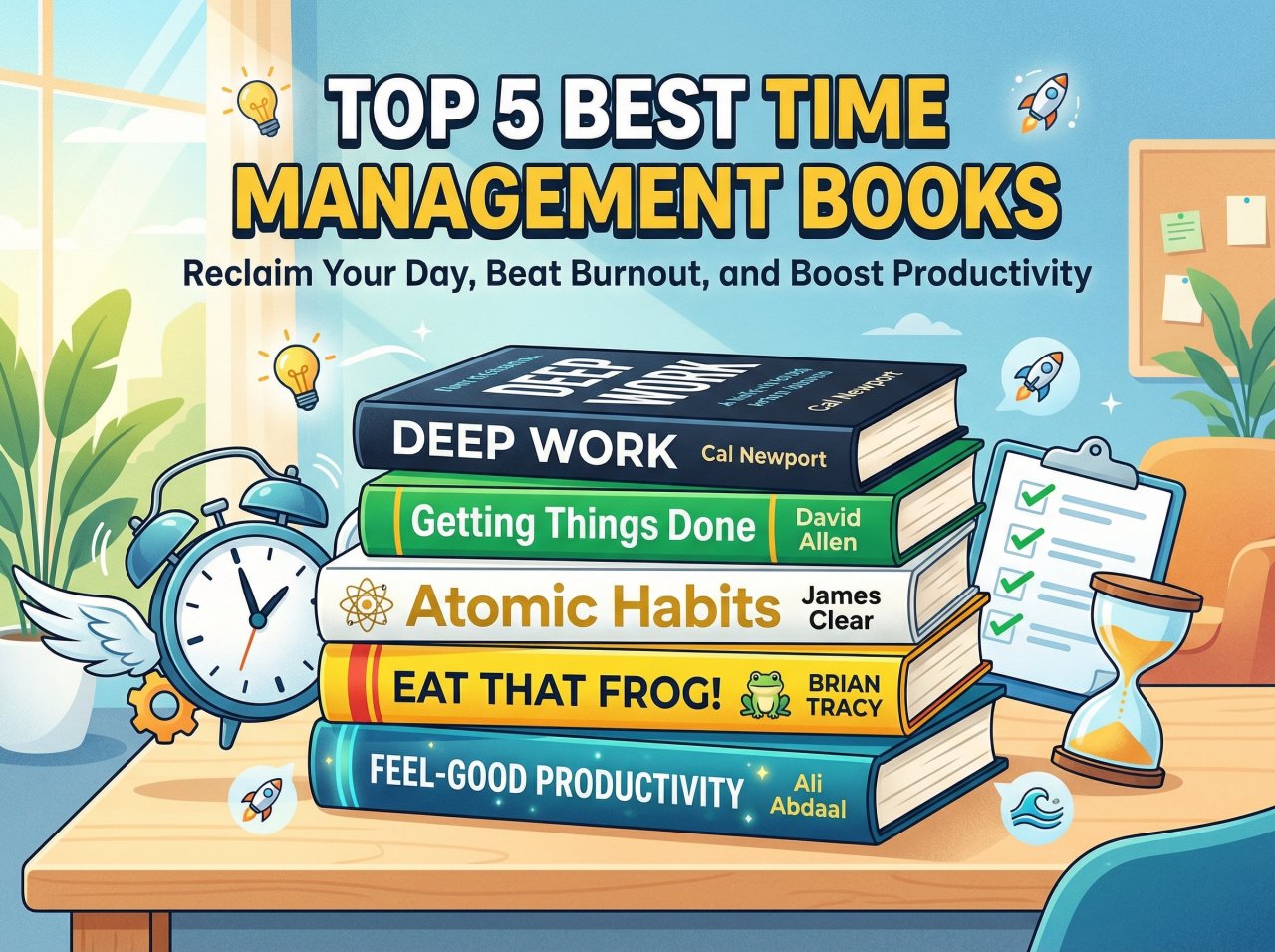

We all get the exact same 24 hours in a day, yet some people seem to conquer mountains while the rest of us drown in overflowing inboxes and endless to-do lists. Sound familiar?
If you are constantly feeling overwhelmed, perpetually behind, and completely exhausted by Friday, the problem isn’t your work ethic—it is your system.
The solution doesn't lie in working harder, but in working smarter. By diving into the best time management books, you can adopt proven productivity frameworks, eliminate procrastination, and permanently change how you interact with your daily schedule.
Don't wait until you burn out. Here are the top reads that will help you take back your time today.
Quick Picks: Top Time Management Books at a Glance
If you are short on time, here is a quick breakdown of our top recommendations.
| Product | Best For | Price | Rating | Action |
| 1. Deep Work by Cal Newport | Mastering deep focus | $$ | 4.9/5 | |
| 2. Getting Things Done by David Allen | Organizing chaotic to-do lists | $$ | 4.8/5 | |
| 3. Atomic Habits by James Clear | Building automated routines | $$ | 5.0/5 | |
| 4. Eat That Frog! by Brian Tracy | Beating severe procrastination | $ | 4.7/5 | |
| 5. Feel-Good Productivity by Ali Abdaal | High output without the burnout | $$ | 4.8/5 |
(Note: Prices fluctuate, click the links to see today's lowest price!)
Comprehensive Product Reviews
1. Deep Work by Cal Newport
The Short Verdict: The absolute gold standard for anyone who needs to concentrate in a highly distracted, notification-heavy world.
-
Pros: Highly actionable strategies, backed by neuroscience, completely shifts how you view "busyness".
-
Cons: The strict scheduling advice can be tough to implement for reactive jobs (like customer service).
-
Best for: Knowledge workers, creatives, writers, and students.
-
Key features: Outlines the "Deep Work" hypothesis, teaches time-blocking, and provides rules for quitting digital distractions.
-
Why we recommend it: Cal Newport doesn't just tell you to put your phone away; he provides a compelling, evidence-based argument for why undivided attention is the ultimate superpower in the modern economy.
2. Getting Things Done (GTD) by David Allen
The Short Verdict: The undisputed bible of organizational systems that will clear your mind and organize your life.
-
Pros: Creates a foolproof "external brain," reduces mental load and stress, highly scalable.
-
Cons: The initial setup phase is time-consuming and can feel overwhelming.
-
Best for: Executives, project managers, and people juggling multiple complex projects.
-
Key features: The 5-step GTD methodology: Capture, Clarify, Organize, Reflect, and Engage.
-
Why we recommend it: This isn't just a book; it's an operating system for your life. If your brain feels cluttered, GTD will help you categorize every thought and task so you can finally relax.
3. Atomic Habits by James Clear
The Short Verdict: While technically a habit book, it is the ultimate time management tool because it teaches you how to put productivity on autopilot.
-
Pros: Extremely easy to read, uses the "1% better" rule, practical habit-stacking templates.
-
Cons: Less focused on daily scheduling and more focused on behavioral psychology.
-
Best for: Anyone struggling to maintain consistent routines or break bad habits.
-
Key features: The Four Laws of Behavior Change, identity-based habits, and environment design.
-
Why we recommend it: Managing your time is useless if you don't have the discipline to stick to your schedule. James Clear shows you how to build micro-habits that compound into massive time savings over months and years.
4. Eat That Frog! by Brian Tracy
The Short Verdict: A punchy, no-nonsense classic that attacks chronic procrastination head-on.
-
Pros: Very quick read, straightforward advice, highly motivating tone.
-
Cons: Some concepts feel a bit dated compared to modern neuroscience-based books.
-
Best for: Chronic procrastinators and people who struggle with prioritization.
-
Key features: 21 specific techniques to stop procrastinating, focusing on tackling your biggest, hardest task (the "frog") first thing in the morning.
-
Why we recommend it: If you only have a weekend to read a book and need immediate results by Monday morning, this is the one to grab. It forces you to prioritize ruthlessly.
5. Feel-Good Productivity by Ali Abdaal
The Short Verdict: A refreshing, modern take on getting things done without destroying your mental health in the process.
-
Pros: Highly relatable, science-backed joy experiments, directly addresses modern burnout.
-
Cons: Experienced productivity nerds might find some of the concepts familiar.
-
Best for: Entrepreneurs, burned-out professionals, and millennials/Gen Z.
-
Key features: Focuses on energy management over time management, utilizing the "Unblock, Energize, Sustain" framework.
-
Why we recommend it: We love this book because it flips traditional hustle culture on its head. Abdaal proves that managing your energy and finding joy is actually the most efficient way to get more done.

Head-to-Head Comparison
Still not sure which book fits your lifestyle? Here is how they stack up against each other.
| Book | Core Philosophy | Primary Focus | Best Feature |
| Deep Work | Focus is a rare, valuable skill | Eliminating distraction | Time-blocking strategies |
| Getting Things Done | Your mind is for having ideas, not holding them | Task organization | The "Inbox Zero" mentality |
| Atomic Habits | Tiny changes yield massive results | Behavioral consistency | Habit-stacking formulas |
| Eat That Frog! | Do the hardest thing first | Prioritization | 21 rapid-fire anti-procrastination tips |
| Feel-Good Productivity | Success doesn't require suffering | Energy management | Burnout-prevention tools |
The Ultimate Buying Guide
Not all productivity advice is created equal. What works for a freelance artist might be a disaster for a corporate manager. Here is what you need to know before you buy.
What to Look For
-
System vs. Mindset: Books like GTD give you a rigid, mechanical system to follow. Books like Deep Work offer a mindset shift. Decide if you need practical organization or a psychological reset.
-
Modern Relevance: Look for books that address modern realities—like Slack messages, endless Zoom meetings, and smartphone addiction.
-
Actionable Blueprints: The best time management books don't just inspire you; they give you templates, rules, and daily exercises to implement immediately.
Who Should Buy Which Book?
-
The Overwhelmed Executive: You need Getting Things Done.
-
The Distracted Creative/Student: You need Deep Work.
-
The Chronic Procrastinator: You need Eat That Frog!
-
The Burned-Out Hustler: You need Feel-Good Productivity.
❌ Mistakes to Avoid
-
Reading without implementing: The biggest trap is treating a productivity book like a novel. Keep a notebook handy and apply the lessons as you read.
-
Trying to change everything at once: Don't try to adopt 15 new habits on the same day. Pick one core takeaway (like doing your hardest task first) and master it before moving on.

Frequently Asked Questions (FAQ)
1. What is the best time management book for beginners?
If you are new to the self-improvement space, Atomic Habits by James Clear is highly recommended. It is easy to digest, highly practical, and teaches the fundamental building blocks of routine management without overwhelming you with complex calendar systems.
2. How do I actually stick to a time management schedule?
The secret to sticking to a schedule is energy management and flexibility. Books like Feel-Good Productivity emphasize that relying on sheer willpower leads to burnout. You need to build buffers into your schedule and align your hardest tasks with your peak energy hours.
3. Will reading productivity books really help me stop procrastinating?
Yes, but only if you take action. Books like Eat That Frog! break down the psychological reasons why we delay tasks and offer immediate, physical steps (like the 5-minute rule) to bypass the brain's resistance to hard work.
4. What is time-blocking and which book teaches it best?
Time-blocking is the practice of scheduling every minute of your day into dedicated "blocks" for specific tasks. Cal Newport's Deep Work is widely considered the best resource for mastering this technique to achieve maximum focus.
5. Are there good time management books for people with ADHD?
While not exclusively for ADHD, Getting Things Done (GTD) is incredibly popular among neurodivergent individuals because it requires you to write everything down in an "external brain," completely removing the burden of having to remember tasks.
Ready to Reclaim Your Schedule?
Your time is your most valuable, non-renewable asset. Stop letting it slip away through poor planning and digital distractions.
If you want an airtight system to manage your tasks, grab
Don't let another unproductive week go by. Pick the book that best fits your current struggle, order it today, and start taking back control of your life!